Um alle Funktionen des Forums nutzen zu können, sollten Sie sich registrieren. Wenn Sie schon regstriert sind, sollten Sie sich anmelden.
Datenschutzerklärung: Hier
Einstellungsmöglichkeiten zur Privatsphäre finden Sie in Ihren Einstellungen.
Einen maschinenlesbaren Export Ihrer Daten können Sie in Ihrem Profil anfordern. Hier
Every two weeks, we accompany the Roadmap update with a brief explanatory note to give you insight into the decision-making that led to any changes. This is part of an effort to make our communications more transparent, more specific, and more insightful for all of you who help to make Star Citizen and Squadron 42 possible.
With that said, let’s go ahead and dive into this week’s Roadmap Roundup!
-CIG Community Team
Notable Changes for May 1, 2024
Progress Tracker
As you might have seen in the recent Letter From the Chairman, our development team is in the process of outlining the necessary tasks to achieve Star Citizen's full 1.0 commercial release. While our production schedule is still in progress, we intend to share a portion of it with you soon by updating the Progress Tracker up to the end of 2024 (with more to be shared later in the year!). We're nearly finished and aiming to provide more details in the coming weeks, so stay tuned to the Roadmap for more information very soon!
Release View
Arena Commander: Grav Royale
The team encountered a critical issue with this game mode that requires additional testing. For the time being, we're removing this card from Release View until this is resolved.
The following features have passed their final review for Alpha 3.23.0, therefore we are toggling their status to Committed:
Distribution Centers
Creating new traversable areas offering gameplay opportunities in corporate industrial environments. This initial release includes the surface levels of the facilities, with underground areas coming in a later update.
Vulkan Graphics API Support
Converting the Star Citizen renderer from DirectX11 to the Vulkan Graphics API. This allows spreading GPU submission work over many CPU cores, and enables many new tech features that were previously unavailable, such as Ray Tracing. Vulkan is able to be opted into via the options menu with this release, but it will eventually fully replace DirectX11 in the future.
Water Simulation & Rendering Improvements
The water in Star Citizen now support a multi-scale GPU wave simulation to support dynamic reaction to thrusters, aerodynamic wake, explosions and collisions. The rendering has also been overhauled, with improved waves, reflections, refraction, underwater fog, and helmet effects.
Volumetric Clouds Update
Updating Star Citizen's volumetric cloud technology to improve overall visual quality and performance, including the addition of both volumetric shadows as well as the implementation of ground fog.
Image Upscaling
Implementing support for GPU upscaling, including DLSS, FSR, and an in-house TSR solution.
Replication Layer Update
Over the course of the 3.21 patch cycle, the Replication Layer will be moved off of the game servers and set up as its own standalone service. In the short term, this allows for greater server recovery in the event of a crash. This is also a critical next step toward Server Meshing.
That's all for this week! No Progress Tracker updates this week as work continues on long-term planning. For further insights into the planning efforts of our production team, we invite you to review the latest Letter From the Chairman.
Join the discussion on Spectrum, and check out the Roadmap Companion Guide for more information on the Star Citizen Public Roadmap.
Roberts Space Industries is the official go-to website for all news about Star Citizen and Squadron 42. It also hosts the online store for game items and…
Inhalte von externen Seiten werden ohne Ihre Zustimmung nicht automatisch geladen und angezeigt.
PU Monthly Report
Welcome to the latest PU Monthly Report, this time detailing all the development progress made throughout April. With the imminent release of Alpha 3.23, most teams began or continued tasks for events and releases coming soon and further into the year.
Read on for the latest updates on jump points, weapon animation, the Anvil Legionnaire, and more.
AI (Features)
Throughout April, AI Features put significant effort into the Alpha 3.23 release, specifically the kopion creature that will be found across planetary surfaces and in caves.
“We’re really excited to share this new creature and the gameplay possibilities it provides. Kopions are the first of the creatures we have been working on and have posed many challenges during their development. We also had the pleasure of bringing all the hard work of other teams into a cohesive whole.” AI Features Team
New features added for creatures include ground alignment tech, which allows them to appear correctly situated when moving across the terrain, and the ability to attack in formation. The attacks themselves require motion warping and melee attack technology to connect with the player. The team also put a lot of effort into ensuring that these functionalities work well across different environments.
AI (Tech)
Last month, AI Tech focused on planetary navigation mesh, with the version implemented recently receiving significant improvements. Firstly, they removed generation limits over planet latitude, which gives stronger coupling with planetary terrain patches, allowing the nav mesh to generate correctly over the planet efficiently. They then improved generation response at lower framerates so that movement over planets in non-ideal performance scenarios results in acceptable nav-mesh generation times.
The multipath code was then optimized to execute faster, which will result in quicker generation of paths into, out of, and between usables. The team also enabled failure detection code in the movement system component to identify and fix situations where NPCs were standing on usables or out of the nav mesh.
Another key feature worked on was the boids system used for the new marok creature. April saw the devs improving network synchronization and extending the system to support audio triggers from different agent states. Several optimizations were also made to the overall code.
Significant time was spent verifying multiple parts of the AI system after evaluating the EPTU optik profiles. For example, the team optimized some of the navigation code involved in the destruction of navigation links and navigation volumes when larger outposts stream out.
The pathfinder was also switched from running using background jobs to batch jobs. The main pool that serves requests was split into two to better serve multipath and standard-path searches. Moving the calculation into batch jobs allows an increased number of calculations, which provides much faster results and utilizes more CPU time where available. These jobs are lower priorities, so they can always provide space for more urgent calculations and continue work across multiple frames. This should result in quicker response times for NPCs at lower FPS.
In parallel with supporting the Apollo Subsumption editor, AI Tech are also working on a new UX design for their internal tool.
Progress was also made on the spaceship combat behavior, which is planned for release in Alpha 3.23. All NPC fighters now use this behavior, which involves them using limited ballistic ammo rather than infinite rounds as before.
Finally for AI Tech, they implemented point defense cannons that will protect capital ships from incoming missiles.
Animation
In April, the Animation team worked on various creatures, including two predators and a prey animal. They also spent time polishing player movement in space and when prone (which will be live in Alpha 3.23) and implemented hit reactions for when AI is out in the open.
The Facial Animation team continued to develop facial animations for various game elements.
Art (Characters)
In April, the Character Art team began work on two specialist armors, reworked a utility armor, and supported requests for the Character Customizer. They also continued working on creatures.
The Character Concept Art team continued developing specialist armors and completed handoff sheets.
The Hair team kicked off new hairstyles for Alpha 4.0 and undertook R&D on fur.
Art (Ships)
The Ships team progressed with the RSI Zeus, continuing with the beauty and polish stage. The cockpit is now greybox complete, which established the standard for the remainder of the ship. The habitation area is receiving the last elements of polish, including resolving the ceiling and personal storage areas. The cargo room ceiling had a pass and the devs began finalizing the walls. The mess hall is nearing completion, as is the central hallway.
Work on the exterior progressed well too, which now has a significantly increased level of detail throughout. The team are currently going through all other sections to ensure they have the same level of detail. Ships also started looking at lighting, including a pass of every room and the entire exterior. Following this, it will be outfitted with proper fixtures.
The Anvil Legionnaire is now whitebox complete, though requests were made to improve its usability when boarding hostile vessels. The devs are currently exploring options for collapsable cover built into the boarding tunnel.
Elsewhere, Resource Network work was finished for 10 ships, while legacy updateswere made to three additional ships to support a new selection of paints.
Audio
For the upcoming Alpha 3.23 release, the Audio Vehicle team completed their first milestone in overhauling the ship audio experience with new thruster sounds, which is rolling out to all new ships.
“The goal was to restructure our process of designing and implementing ship thruster audio in order to unify the setup of all ships and streamline our pipeline. This ensures that sound designers will have fewer sounds to design, but every asset will have a greater impact. Our objective was to immerse our pilots in hard-hitting and reactive sounds, resulting in a memorable flight experience, whatever ship they choose to fly.” Audio Team
They are now also using a shared and extensive set of game parameters that modulate different layers in a variety of ways. This, paired with a more extensive matrix of generic assets designed to fit manufacturers, classes, and sizes of ships, results in a much more granular and interactive experience for the player while giving every brand a clear sonic identity. This is supported by bespoke sounds made individually for every ship to give them all a unique flavor.
Finally for Vehicle Audio, the devs introduced a very early state of manufacturer-based soundproofing – with this, each brand will have a unique soundproofing profile, heard when players are in first person, to further improve immersion. The new thrusters and audio features were rolled out with the Anvil F7A Hornet Mk II and will be utilized on every new ship going forward, with the team converting older ships periodically.
The Audio Environment team polished the first ambience pass for Distribution Centers while continuing to develop new systemic ambience. Although this new system is still early in development, the team was able to add it into the Distribution Centers, improving ambience for players at these locations. Alongside this, the team finished their pass on the new features for Alpha 3.23, including wildlife.
Community
The Community team started the month by celebrating Triggerfish with the announcement of the MISC R.A.P.T.O.R, the ultimate weapon in the war against garbage! They also supported the April Fools' Arena Commander mode.
Regarding upcoming updates, the team published the Alpha 3.23 Patch Watch, which highlights the features and improvements that do not appear on the Public Roadmap.
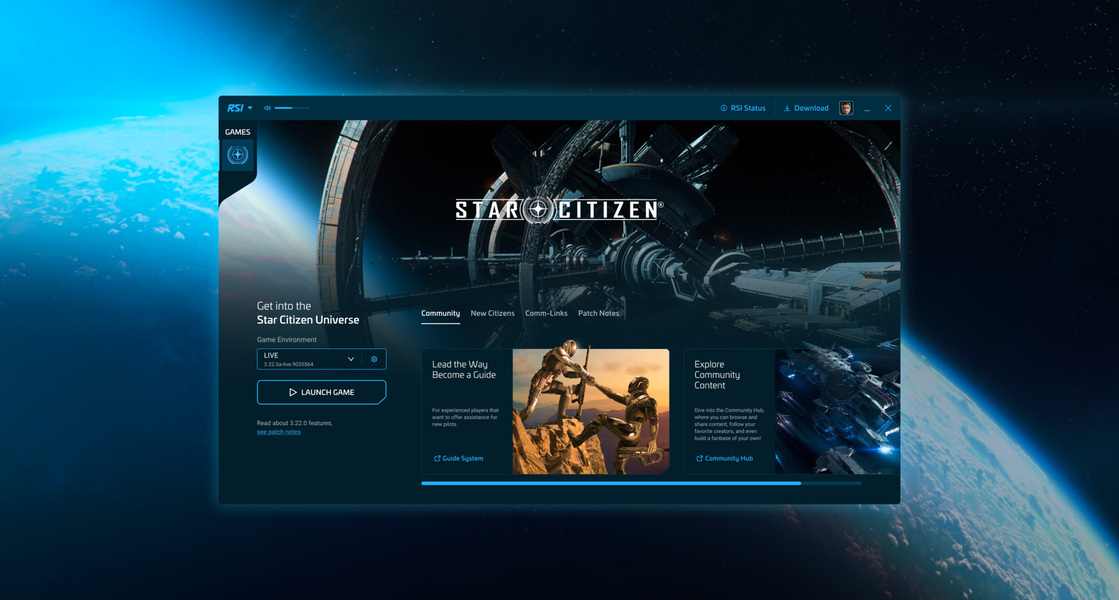
The team also supported the live release of the RSI Launcher 2.0 - a full revamp of the application with the ultimate goal of serving as a reliable tool for the community.
The Bar Citizen World Tour continues in 2024, with team members joining the fun in Chicago this month. For those looking forward to a future event, a more detailed schedule for this year's Bar Citizen World Tour will be published soon.
Inhalte von externen Seiten werden ohne Ihre Zustimmung nicht automatisch geladen und angezeigt.
Planning for this year's CitizenCon in Manchester, UK, on October 19-20, is underway.
"With over 3,700 tickets already claimed, this year's CitizenCon has already shattered previous attendance records, marking it officially the largest Star Citizen event yet! Despite still being April, the team is already deep in planning for the layouts and key components of this year's show and can't wait to see you all in Manchester this October!" Community Team
In addition, the annual community-created System 7 Racing League, organized by ATMO Esports, is ongoing, with the team continuing their support for the event.
Finally, the Community Team published the weekly This Week In Star Citizen schedules alongside the most recent updates on the upcoming gameplay features in Roadmap Roundup. The Arena Commander Schedule was also updated to provide better visibility on game mode rotation and special modes. Besides these, many other support tasks were done to prepare for Alpha 3.23, 4.0, and beyond.
Core Gameplay
In April, the Core Gameplay Pillar closed out features and prepared them for release in Alpha 3.23. A significant amount of time was invested into polishing and bug fixing as well as reviewing feedback from the community to improve features where possible.
For example, various improvements were made to weapons, including enabling the interrupting and canceling of backpack reloading and ammo repooling via actions like weapon swap, sprint, and melee.
Support was also added for hit-marker sounds, while recoil patterns are now the same for tap-firing and holding the fire button.
ADS mouse sensitivity is not scaled down for higher FOVs anymore, and weapon bandwidth usage was improved.
For jump points, the team enabled new fail states if a jump drive detaches or stops functioning and added tunnel push force from the edges of the map to help players stay on course. They also implemented the first pass of procedurally generated tunnels from design parameters, including randomness to tunnel shapes for variety.
For the resource network and engineering, the team implemented a throttle that manages power in one-SCU segments based on the updated UI design.
Additional item power range modifiers were added, which enable extra behaviors currently used for heat generation. This entered optimization for eventual release.
For the life support and room system, the team implemented filters that degrade over time, with the life-support generator ceasing to work once all are used.
Gas propagation now uses accurate positioning within rooms, while atmospheres will equalize differently depending on whether they’re high or low-atmosphere environments.
The technical requirements for crafting were scoped out with Design, and room-system documentation was updated to enable other teams to better implement their work.
April saw continued work on Maelstrom and the radar and scanning feature.
Planning continued for the transit refactor, and fixes were made for various analytic events not reporting correctly.
For Arena Commander, the team began refactoring the Spectator module and player component. They also updated how Arena Commander uses comm-link notifications and completed a pass over various game modes and awards for Alpha 3.23.
Changes were made to Pirate Swarm’s final wave, which now uses two Idris capital ships. Gun Rush now supports multiple weapon lists (controlled by badges) that can be randomized from all enabled weapons.
VOIP and mute/unmute were added back into Arena Commander too.
Further development was done on the Contracts Manager, with the team providing code support for cargo hauling missions. ‘Or’ missions were added back in, where players can choose between objectives, and general bug fixing was done.
Reputation-based hostility was further worked on too. Alongside several issues and improvements, a new neutral zone was added. This is a special restricted area that all players have permission to be in, with NPCs ignoring reputation relationships and criminality and reacting neutrally to everyone. However, access will be revoked for any non-justified hostile act, with everyone else seeing that person as hostile and attacking accordingly.
To regain access after hostile actions, the offending player will need to exit the zone and wait a set amount of time before entering again. Remaining inside when hostile or entering before the allotted time will completely reset the timer.
For cargo, Core Gameplay progressed with freight elevators, item banks, and persistent hangars.
In-Game Branding
Last month, the Branding and Vehicle teams worked closely to create brand identities for upcoming and existing vehicles within the game.
They also continued to develop an in-house tool for all manufacturers, from ships to signage. This will be a versatile and invaluable tool for everyone working on the game and lead to the unification of the different brands across the entire game.
Interactables
The Interactables team completed their work on fire extinguisher recharge cabinets, including both high-tech and low-tech versions. These will be placed in hangars for convenience and aid in ship-fire gameplay.
Inhalte von externen Seiten werden ohne Ihre Zustimmung nicht automatisch geladen und angezeigt.
Lighting
Lighting spent time in April polishing Distribution Centers before moving on to instanced hangars and freight elevators, with the aim of making every interaction an engaging event.
Locations
The Locations teams spent April closing out features for Alpha 3.23. For example, the Sandbox team completed Distribution Centers, adding the last elements of polish before shipping. The team are looking forward to players getting their hands on these locations and will be looking for feedback that they can take forward as Distribution Centers evolve in the future.
Inhalte von externen Seiten werden ohne Ihre Zustimmung nicht automatisch geladen und angezeigt.
The Sandbox team are currently finalizing the last few outposts going into Pyro for Alpha 4.0 whilst supporting other Locations teams with their tasks for the upcoming patch release.
The Landing Zone team finalized art for the cargo initiative and helped out other teams on Alpha 3.23.
Inhalte von externen Seiten werden ohne Ihre Zustimmung nicht automatisch geladen und angezeigt.
Mission Design
Last month, Mission Design continued to polish content for Alpha 3.23, including XenoThreat and fauna-related missions. They also made quality-of-life improvements to missions, including Missing Persons, and supported content for Distribution Centers.
Work was done on the new Contracts Manager to ensure it has all the existing functionality alongside improvements. They also made the Commodity Update Journal entry a lower-priority notification and reassessed what missions notify players when they’re available. Further bug fixing was done for Overdrive Initiative too.
The team then used the extra time until the cargo updates to add additional high-quality content and further polish the Cargo Hauling and Kill and Collect missions:
“The various shipping companies of Stanton often outsource cargo hauling to freelancers through contracts. These job-board missions task the player with picking up the designated cargo shipment at one or more locations andoffloading it at one or more destinations. At their core, these missions will test the player’s knowledge of their ship’s specs and their ability to weigh the time spent loading and traveling against the payout.
They will see the player transport goods back and forth to various jump points, LEOs, Lagrange points, landing zones, and Distribution Centers. These goods consist of various commodities and vehicles of real value, allowing players to get a rudimentary sense of what it will be like to have a hauling career. Simultaneously, this represents our first step toward implementing the logistical structure of the ‘verse in a tangible, playable form, prior to a Quanta-controlled system.” Mission Design Team
Narrative
April was a very busy month for the Narrative team, who worked hard preparing for the Alpha 3.23 patch. This included crafting new Distribution Center missions, creature-hunting missions, polishing the new UI layouts, and reworking hint text alongside bug fixing.
Looking ahead, the team helped with the upcoming Invictus Launch Week, making sure everything is ready for players to visit in-game. This was a particular focus of the Narrative Design team, who looked at the NPCs attending the event. The team also spent time working on cargo gameplay, providing UI and mission support.
Additionally, the Narrative team did a lot of planning and pre-production work for Star Citizen 1.0, detailing the scripts and assets that will be needed for its release. This includes looking at legacy work done in the game’s early releases and analyzing how best to update it to meet current standards.
After several sprints, the Online Services Team completed their refactor of the social services backend. This involved porting the services to gRPC, as well as making updates related to server meshing.
Online Services also completed work relating to EAC anti-cheat in preparation for enabling the enforcement of sanctions. This is currently going through the first round of QA testing. The team also supported Alpha 3.23 by bug fixing and helping triage performance issues.
Over the past month, the Live Tools Team worked to ensure compatibility between the Network Operation Center in Hex and the modifications being made on the services side for version 3.23. They're also implementing new modules to assist different types of users.
Additionally, the team continued to enhance other internal development tools and provide support and maintenance.
R&D
R&D spent April supporting Alpha 3.23. For example, the half-resolution render mode was updated to accompany the new cloud rendering improvements and the introduction of ground fog.
This mode serves as a good compromise between quality and performance and will be superseded by the temporal render mode, which is still a work in progress. Improvements include the cleaner rendering of silhouettes and foliage, less blurry results from orbit, and better low discrepancy sampling. Due to these improvements, the decision was made to alter the ‘very high spec’ settings for clouds to use the half-resolution render mode and increase the number of raymarching steps. As a result, players will see more consistent and less-noisy cloud rendering (similar to the new "photo mode" quality setting) at reduced GPU cost compared to the previous ‘very high spec’ settings. This will hopefully allow more people to enjoy the new high-fidelity rendering improvements in-game.
Additionally, further support was given to the Rendering team to roll out PSO caching and request collection to eliminate PSO cache redundancies and certain shader flags for vertex position and texture coordinate modification. This is to minimize the number of shaders and PSOs needed to run the game.
Support was also given for various Vulkan issues that were revealed during PTU play testing.
Longer term, work progressed on the temporal render mode. All confidence metrics, which are used to decide whether to keep history data after reprojection, now also factor in scene motion and depth. The temporal render mode was also tested against the various temporal upsampling solutions supported by the renderer.
Tech Animation
The Tech Animation team continued to generate and implement new head assets to the DNA gene pool, and are not far from completing the initiative of 40 heads for each gender.
Many devs are currently dealing with the complications of players and NPCs putting on and taking off clothes live in the engine.
“This has been ongoing for some time and, with the addition of animation resources into the mix, we are seeing great headway in both generating the assets for animation and generating usable pipelines to expedite the entire process for everyone involved.” Tech Animation Team
Additionally, the team are intrinsic in the creation and implementation of new creatures for both the PU and SQ42.
They’re also involved in work toward consumables and the setup of foodstuffs, with the team aiming to guide this initiative and promote time-saving workflows.
Lastly, they continued to support Alpha 3.23, ensuring content is integrated, tested, and ready for players.
Tech Design
Tech Design provided general tech support for Alpha 3.23, including fixing bugs affecting doors and fuel tanks not exploding in the new Distribution Centers.
For ships, iteration was done on weapon balance and AI following director feedback. For the latter, an easier AI behavior was created for use in very easy, easy, and introductory missions.
A call-to-action prompt was added to the elevator panels of multiple ships, and an issue preventing players from getting out of bed in the MISC Freelancer was fixed.
For Arena Commander, work continued on the Resource Network game mode, including enabling doors without power to be openable (but not closable) to prevent players from being trapped.
UI
In April, the Montreal-based team focused on the Cargo feature and worked closely with Core Gameplay on the Resource Network mandate, which included getting wireframes signed off. They will begin creating mockups soon.
In the UK, the UI team added the final touches to the new UIs for the visor, mobiGlas, and maps. They added the final missing features, such as the chat window and law widgets, too.
Updates were also made based on player feedback, such as reducing the hologram effect on the HUD and bringing back differently shaped quantum-travel markers. The team spent time polishing visuals and bug fixing as well.
VFX
Last month, the VFX team focused on bug fixing for the upcoming patch. This involved playtesting the game to find major issues that needed solving immediately or identifying smaller issues that were safe enough to fix without risking creating other bugs.
They also worked closely with Graphics and Planet Tech to ensure the supporting effects for water were working as expected and not too expensive. They also worked on a variety of vehicles for an upcoming release.
Roberts Space Industries is the official go-to website for all news about Star Citizen and Squadron 42. It also hosts the online store for game items and…
Inhalte von externen Seiten werden ohne Ihre Zustimmung nicht automatisch geladen und angezeigt.
Happy Monday, everyone!
We'd like to extend a massive thank you to everyone who has taken the time to hop into the PTU to kick the tires of the upcoming patch! Your participation has been instrumental in helping us address known issues, and it has paved the way for the team to develop additional fixes currently in the pipe. Alpha 3.23 is now available to Wave 3 testers, with more waves opening up soon.
The community's enthusiasm for CitizenCon 2954 has truly been mind blowing! With premium tickets completely sold out and only a couple hundred general admission tickets remaining, we've already shattered the attendance records of all previous Star Citizen events! Our team is currently deeply entrenched in CitizenCon preparations, and we're excited to bring you what's shaping up to be an unforgettable event this October. See you in Manchester!
Now, let's see what's going on this week:
Wednesday brings a wealth of development updates, with April's Monthly Reports and the Roadmap Update coming your way.
Thursday's Inside Star Citizen is Patch Dispatch 3.23, where we run down the big features and content arriving in Alpha 3.23, including the introduction of a new vehicle that's sure to get hearts racing.
On Friday, Star Citizen Live is All About Alpha 3.23, with special guests Rich Tyrer, Rick Porter, and Jonny Jacevicius answering your questions about the upcoming release, so don't forget to ask yours on the Spectrum thread. The show will go on live Twitch at 15:00 UTC / 8 AM Pacific.You'll also find our weekly RSI Newsletter directly delivered to your inbox, and Jump Point magazine is back for all subscribers.
Lastly, on Saturday, our friends at ATMO esports have teamed up with BE@Con to bring you an exhibition race for the ages! Catch some slick moves and high octane action on microTech, live on ATMO's Twitch channel from 13:00 UTC.
Fly low, and fly fast!
The Weekly Community Content Schedule
MONDAY, APRIL 29, 2024
This Week in Star Citizen
WEDNESDAY, MAY 1, 2024
Star Citizen Monthly Report - April 2024
Squadron 42 Monthly Report Newsletter - April 2024
Inhalte von externen Seiten werden ohne Ihre Zustimmung nicht automatisch geladen und angezeigt.
We're constantly amazed at the contributions made by the Star Citizen community. Whether it's fan art, a cinematic, YouTube guide, or even a 3D print of your favorite ship, we love it all! Every week, we select one piece of content submitted to the Community Hub and highlight it here. The highlighted content creator will be awarded an MVP badge on Spectrum and be immortalized in our MVP section of the Hub.
Inhalte von externen Seiten werden ohne Ihre Zustimmung nicht automatisch geladen und angezeigt.
XingKongCFR delivers explosive battles, daring escapes, and intense showdowns in this adrenaline-fueled trailer for fan-made micro-movie 'Lucky 13.' If this trailer is any indication of the final product, we can't wait to see it!
Roberts Space Industries is the official go-to website for all news about Star Citizen and Squadron 42. It also hosts the online store for game items and…
Join us today as members of the UI feature team throw a bone at answering your questions about the upcoming UI changes coming in Alpha 3.23 including mobiGlas, Starmap and more!
Roberts Space Industries is the official go-to website for all news about Star Citizen and Squadron 42. It also hosts the online store for game items and…
Which of the upcoming Arena Commander updates are you most excited about? Join us today to explore new maps, racetracks, experimental modes, custom lobbies, and the first iteration of engineering gameplay coming in Alpha 3.23.
Roberts Space Industries is the official go-to website for all news about Star Citizen and Squadron 42. It also hosts the online store for game items and…
Inhalte von externen Seiten werden ohne Ihre Zustimmung nicht automatisch geladen und angezeigt.
This portfolio originally appeared in Jump Point 11.03.
When MISC CEO Irena Adjei first saw the Fury prototype she spent over an hour slowly circling the ship and assessing the compact fighter from every angle. “It feels both distinctly MISC and something all its own,” she told the MISC board. “I’m convinced we should make it, but I don’t think MISC should.” With those words Adjei proposed a solution to a debate that had bitterly divided the company’s board of directors between members who believed MISC should focus on industrial ships and those hoping to expand the brand. CEO Adjei had never taken a side until the day she proposed a solution that would satisfy both; the creation of the sub-brand Mirai.
Meaning ‘Future’ in Japanese, the name Mirai honors the settlers of Centauri, home to MISC’s headquarters, and embodies its goal of creating the next generation of ships. The creation of a subbrand also allows MISC to retain its cherished industrial identity, while providing the company an outlet for experimentation. Adjei argued that the Fury should launch the sub-brand, and convinced the board by showing them what the Fury team was working on next. The creation of the Mirai sub-brand shocked many within the industry and marked the most significant change to the company in decades.
BEYOND INDUSTRY
MISC may be known for its industrial ships but its desire to develop other variants goes back to 2833. Less than twenty years after the merger that created MISC, CEO Kori Desmon pushed the company to expand its portfolio. The success of the Hull series provided financial stability and budget surpluses that Desmon wanted to invest in ships that took the brand beyond the industrial sector. Yet a coalition of board members believed in staying laser-focused on industrial ships and forced Desmon to scale back their ambitions to a single design team working on a dedicated racing ship. The result would be Daedalus.
Daedalus was developed from the ground up to be an extremely fast, high-performance ship that could endure the rigors of racing. An impressive prototype inspired MISC to sponsor a racing team and share its tech with them as opposed to releasing the ship itself. The design team disagreed with this decision, but company executives convinced Desmon that a dedicated racing team would provide insight and experience their own designers lacked. While the ship impressed racing fans, Daedalus continually failed to qualify for the professional division of the Murray Cup, a goal that Desmon knew needed to be accomplished in order for the ship to get mass produced. Experimental materials and production techniques used on Daedalus meant MISC’s existing production lines couldn’t be used to manufacture the ship, so state-of-the-art production facilities would need to be constructed. Though Daedalus was floundering, the board still considered the racing team a great marketing tool and continued to sponsor it. Desmon officially designated the team that built Daedalus as MISC-M and assigned it to be the liaison between the racing team and the company.
While delivering upgrades for Daedalus became part of MISC-M’s working orders, the division was also directed to produce innovative and imaginative new ship designs with no mandate to keep them industrial. Most of these designs would remain theoretical, as the division’s miniscule build budget was almost exclusively reserved for testing Daedalus improvements. By now the division carried a reputation as being where inexperienced designers learned and old designers faded away. In reality, it became a training ground where youngsters honed their craft under the tutelage of veterans who enjoyed the freedom of exploring unique and unusual designs.
Decades of constant tinkering on Daedalus increased the ship’s performance, with it ultimately graduating to the Murray Cup professional division in 2898. The MISC racing team has been a regular qualifier ever since. MISC-M also developed and carefully cataloged thousands of designs for everything from full ships to components to ship furnishings, but it never ushered any new ships into the prototype phase. Instead, any interesting ship directions were reassigned to other teams where they were molded to acceptable MISC parameters or eventually scrapped. Every few years some members of the board would argue for shutting down MISC-M or folding it into another division, but the majority continued to support its mission. This deep well of innovative and unorthodox ideas would become more important than ever when MISC signed the landmark lend-lease agreement with the Xi’an in 2910.
ALIEN INFLUENCE
Following the agreement’s signing, MISC quickly put the newfound wealth of knowledge and resources to good use. The Freelancer, released in 2915, utilized Xi’an tech to transform it into the beloved industrial hauler known today. Despite this success, MISC discovered its traditional design teams struggled to integrate Xi’an tech or use its influence to push further innovations. Eventually, the out-of-the-box thinkers in MISC-M were tasked with evaluating the influx of Xi’an ideas and imagining uses for them. The division also combed through its massive design database to see what ideas could benefit from Xi’an tech. The first design pulled was for Daedalus.
Much had changed since the original Daedalus, but the team saw massive potential in using Xi’an tech to make it fly faster and be cheaper to manufacture. Further upgrades and innovations were developed, but they remained untested until 2940 when MISC decided to pour more money into its racing operations. The company ended its partnership with the outside racing team and tasked MISC-M with building the new ship. The result was the Razor, which would win the Murray Cup Classic Race in 2945 thanks in part to the piloting heroics of Trevor Yuman. Upon its release in 2947, the ship sold extremely well and received rave reviews. The Razor’s commercial and Murray Cup success, combined with the triumphant launch of the Reliant a year earlier, convinced MISC to continue developing bold new ships. The company dramatically increased the funding and staffing levels of MISC-M and directed the team to develop the ideas that excited it the most.
Over the following years, CEO Adjei took great interest in MISC-M and frequently visited the division to check on its progress. She encouraged it to embrace MISC values but refresh the aesthetic. Meanwhile, Adjei told the board that the division had the potential to significantly boost company revenues. Insiders believe she long wanted to make the division its own sub-brand, partially to enshrine its mission and ships as distinctly different from MISC, but didn’t want to reveal her plan until it produced a second signature ship. The Fury would be that ship and inspired CEO Adjei to unveil her master plan. Once approved by the board, the company also decided to make the Razor part of Mirai. It might have been released under MISC but the ship’s history within the division and its ties to the original Daedalus made it an ideal fit. What comes next from MISC’s performance sub-brand remains a mystery to anyone outside the company. Rumors claim that Mirai will push the integration of Xi’an tech to bold new levels, leaving ship enthusiasts and competitors in eager anticipation of what will come next.
Roberts Space Industries is the official go-to website for all news about Star Citizen and Squadron 42. It also hosts the online store for game items and…
Inhalte von externen Seiten werden ohne Ihre Zustimmung nicht automatisch geladen und angezeigt.
Happy Monday, everyone!
Alpha 3.23 is now available to Wave 2 testers! We'd like to take a moment to thank all of you who have taken the time to dive in and check out all of the new content on the PTU. Our team continues hammer away at remaining issues to help improve stability, and if all goes well, we'll open to more testing waves soon.
In other news, the response to CitizenCon 2954 has been nothing short of extraordinary. With tickets now available, we've already exceeded attendance records from any previous Star Citizen gathering to date, and we expect to fully sell out soon. As we speak, our team is gathered in Manchester, meticulously planning what's shaping up to be our best show to date. We can't wait to see you this October!
Speaking of gatherings, Chad McKinney and I (Jake) joined in on the fun at Bar Citizen Chicago over the weekend. More than a hundred of you showed up for good food, great discussions, and a heap of giveaways. As always, these events really charge us up for the journey ahead - thank you for coming out! We're excited to share more information on the continuation of the Bar Citizen World Tour very soon. Stay tuned!
Inhalte von externen Seiten werden ohne Ihre Zustimmung nicht automatisch geladen und angezeigt.
Now, let's see what's going on this week:
This Tuesday, the Narrative Team has a post from the Jump Point Vault: the manufacturer portfolio for our newest vehicle-maker, Mirai.
This Thursday, Inside Star Citizen will have the latest on the updates coming to Arena Commander in 3.23, from new game modes to the return of custom lobbies.
And, on Friday, enjoy a Star Citizen Live Q&A session with our UI team. Be sure to get your questions in on everything maps and mobiGlas on the dedicated Spectrum thread before show time on Friday at 8 AM Pacific / 3 PM UTC. You can also expect to receive the weekly RSI Newsletter, delivered straight to your inboxes, as well as the April issue of Jump Point for subscribers.
Inhalte von externen Seiten werden ohne Ihre Zustimmung nicht automatisch geladen und angezeigt.
We're constantly amazed at the contributions made by the Star Citizen community. Whether it's fan art, a cinematic, YouTube guide, or even a 3D print of your favorite ship, we love it all! Every week, we select one piece of content submitted to the Community Hub and highlight it here. The highlighted content creator will be awarded an MVP badge on Spectrum and be immortalized in our MVP section of the Hub.
Inhalte von externen Seiten werden ohne Ihre Zustimmung nicht automatisch geladen und angezeigt.
Dive headfirst into FatBird's electrifying Machinima as he delivers a high-energy roleplay review of the Greycat STV, taking you on a thrilling journey through mind-blowing scenarios!
Roberts Space Industries is the official go-to website for all news about Star Citizen and Squadron 42. It also hosts the online store for game items and…
Following the To and Fro episode of Inside Star Citizen, "Cargo Chad" joins us today to answer your questions and provide updates on the current state of Cargo, Freight Elevators, Personal Hangars, and more!
Roberts Space Industries is the official go-to website for all news about Star Citizen and Squadron 42. It also hosts the online store for game items and…
How do water wizards make a splash? Join us today to explore the complex nature of how our "hydro homies" are engineering water simulation to appear more immersive than ever before.
Roberts Space Industries is the official go-to website for all news about Star Citizen and Squadron 42. It also hosts the online store for game items and…
Every two weeks, we accompany the Roadmap update with a brief explanatory note to give you insight into the decision-making that led to any changes. This is part of an effort to make our communications more transparent, more specific, and more insightful for all of you who help to make Star Citizen and Squadron 42 possible.
With that said, let’s go ahead and dive into this week’s Roadmap Roundup!
-CIG Community Team
Notable Changes for April 17, 2024
Release View
As part of our final review process, we've concluded that the quality of the Cargo features that were targeting the launch of Alpha 3.23.0 are not yet at the stage where we need them to be for a release to the live servers. The Freight Elevators and Instanced Hangars in particular are technologically complex features that will require a bit more work before we feel comfortable fully integrating them into the game. This additional time allows the team to test for additional edge cases and include further refinements, which is especially important for features as impactful as these. However, we are not currently planning on shifting them back a full patch cycle. The features below will remain in the 3.23 column on Release View, but are now targeting a 3.23.X release:
Item Banks
Personal and Instanced Hangars
New Missions - Cargo Hauling
Freight Elevators
The following features have been added to Release View, targeting a 3.23.0 release:
Vulkan Graphics API Support
Converting the Star Citizen renderer from DirectX11 to the Vulkan Graphics API. This allows spreading GPU submission work over many CPU cores, and enables many new tech features that were previously unavailable, such as Ray Tracing. Vulkan is able to be opted into via the options menu with this release, but it will eventually fully replace DirectX11 in the future.
Water Simulation & Rendering Improvements
The water in Star Citizen now support a multi-scale GPU wave simulation to support dynamic reaction to thrusters, aerodynamic wake, explosions and collisions. The rendering has also been overhauled, with improved waves, reflections, refraction, underwater fog, and helmet effects.
The following features have passed their final review for Alpha 3.23.0, therefore we are toggling their status to Committed:
mobiGlas Rework
Reworking the mobiGlas system to use Building Blocks, which will also allow for easier development of mobiGlas apps. This update includes reworked Home, Maps, Contract Manager, and Journal apps.
FPS Loot Screen
Introducing a new screen for looting critical items quickly, allowing for more reliable inventory management in tense situations.
FPS Map System
Implementing a minimap for the HUD as well as interior maps for FPS gameplay, helping players stay oriented in close-quarter encounters.
Visor & Lens HUD Rework
Converting the Visor and Lens systems to Building Blocks for improved performance and flexibility.
Player Interaction Experience
Implementing the updated Player Interaction Experience; a holistic array of complimentary features and systems, all related directly to the player. Player status, item status, environment status, as well as interactions with both the game world and the objects within it, are covered under these systems.
EVA T2
Improved EVA controls and animations for smoother traversal in Zero-G. Introduces limited EVA fuel and encourages the use of zero-G push/pull and the Multi-Tool's tractor beam.
Starmap Rework
Implementing the new and improved Starmap with improved visuals and usability, including easier search and trip planning functionality.
Master Modes
Implementing new modes to vehicles to manage their speed, components, and role-specific functions. This release introduces the NAV and SCM modes, as well as a complete re-tuning of all ships.
New Missions - Creature Hunting
New missions that require players to locate, kill and retrieve valuable parts of creatures roaming the environment.
Fauna - Kopion
Populating the persistent universe with the Kopion, an aggressive, agile animal that travels in packs. You'll find them in a variety of areas, from grassy fields to lurking in the darkness of caves.
Fauna - Marok
Populating the persistent universe with the Marok, a passive flying bird-like creature. Maroks live in flocks and are often found near lush, green environments.
Arena Commander: Engineering Experimental Mode
Three Limited Test Experimental Modes featuring the engineering gameplay (also referred to as "Resource Network") showcased at CitizenCon 2953. Help shape the future of engineering gameplay in Star Citizen by testing and giving feedback to the features and balance showcased in this limited test before it hits the Persistent Universe.
Arena Commander: Grav Royale
Embark on high-speed mayhem in a thrilling new game mode: Grav Royale! Engage in intense vehicular combat across diverse maps, mastering your Gravlev vehicles to outmaneuver foes and seize victory in this gravity-defying battle arena.
Arena Commander: Custom Lobbies
Custom Lobbies, previously referred to as “Private Matches”, makes their return to Arena Commander. Utilizing the new Frontend & Lobby Systems, Custom Lobbies allow players to set up and play matches for any game modes on any map at any time, with their own rules.
Arena Commander: New Flight Map - Miner's Lament
Miner's Lament, previously exclusive to racing & part of the Master Modes tests, now opens its treacherous asteroid-laden expanse to all flight modes. Dogfight in the chaotic beauty of Yela's ring for an intense, dangerous, close quarters showdown.
That's all for this week! No Progress Tracker updates this week as work continues on long-term planning. For further insights into the planning efforts of our production team, we invite you to review the latest Letter From the Chairman.
Join the discussion on Spectrum, and check out the Roadmap Companion Guide for more information on the Star Citizen Public Roadmap.
Roberts Space Industries is the official go-to website for all news about Star Citizen and Squadron 42. It also hosts the online store for game items and…
Inhalte von externen Seiten werden ohne Ihre Zustimmung nicht automatisch geladen und angezeigt.
Squadron 42 Monthly Report
This is a cross-post of the report that was recently sent out via the monthly Squadron 42 newsletter. We’re publishing this a second time as a Comm-Link to make it easier for the community to reference back to.
TO: SQUADRON 42 RECRUITS
SUBJ: DEVELOPMENT UPDATE 04:10:2024
REF: CIG UK, CIG DE, CIG LA, CIG TX
FAO Squadron 42 Recruits.
Welcome to March’s Squadron 42 development report. Enclosed you will find details on the latest progress made across the campaign, including planetary tech, ship behaviors, and fluff terminals.
Thank you for your continued support of Squadron 42.
Sincerely,
CIG COMMUNICATIONS
AI (Content)
In March, AI Content made improvements to interactivity aboard the Javelin Gauntlet by introducing dynamic conversations, greetings, and “I’m busy” dialogue for NPCs. This was in response to playtesting, as it became evident that players sought closer interactions with NPCs, prompting the integration of reactive responses.
Also a result of feedback from playtesting, the length of the trolley was reduced to a four-box configuration. This decreases the time spent stacking and unstacking and increases time traveling, which was preferred. Elevator travel with the trolley was also polished to eliminate clipping issues upon exiting elevators. Additionally, an extra front stack spot was incorporated for enhanced trolley functionality, as NPCs looked “robotic” without it.
The bed mattress was rigged for deformation, enabling realistic movement when NPCs sit or sleep on it, adding an additional layer of detail to the environment.
The final touches were also applied to bed-bunk animations, enhancing the realism of NPC actions such as sitting, reading, watching TV, and sleeping for a more immersive experience.
NPC interactions with wall-based buttons, such as those for calling elevators, can now accommodate 45-degree approaches. Furthermore, AI can carry boxes and press buttons simultaneously, eliminating the need to drop items to interact with doors or elevator controls.
Refinements to scripted walking behaviors within the ship’s corridors are ongoing to ensure NPCs move convincingly while avoiding critical scenes.
AI (Features)
March saw the AI Feature team continuing to iterate and polish features for specific level scenarios. They also worked through some technical debt, refactoring the AI weapon system to remove bugs, simplify the code, and make the development of new functionality and features easier.
AI (Tech)
AI Tech fixed bugs and made small improvements to NPCs using elevators and using trolleys to move boxes.
They also progressed with the major task of improving and polishing NPCs driving ground vehicles, which involved adding a new pathfollower for driving movement requests. They also implemented an improved controller system for vehicles by utilizing two PID controllers to control steering and requested velocity. Now, NPCs will stick closer to the designated path without overshooting during turns. The next step is iterating on the collision-avoidance system to work as intended when NPCs need to avoid other ground vehicles or characters.
Animation
Last month, the team worked on animations and design work for multiple story scenes and background elements, including life aboard the core ship and on various space stations. Progress was also made on EVA, combat animations for various enemy classes, and assets and design for utility functionality.
The team are currently improving AI leisure on the core ships and working toward a final result for the first two dressing animations.
Gameplay Story
Gameplay Story made substantial progress on chapter one. This involved revising the ‘golden path’ through the level, which led to several scenes being adjusted.
“Everyone seems happy with the new layout and the level appears to flow much better now.” Gameplay Story Team
New mo-cap was shot to overhaul several chapter-one scenes and is currently being implemented.
“This work looks really promising and we can't wait to see the positive impact this will have on the chapter.”
Alongside this, text now appears on a character's mobiGlas screen as they dictate a message.
For chapter four, a huge update was completed on a complex two-person scene. This now uses standard datapads throughout, which can be holstered and unholstered from the characters’ legs before and after the scene. This looks better, brings the scene more in line with the rest of the game world, and makes the setup a lot cleaner
Finally, the team received further audio and facial data for chapter five, which was incorporated into the relevant scenes.
Graphics & VFX Programming
Throughout March, much of the department’s focus was on bug-fixing the various features initially developed for SQ42 currently being implemented into the Persistent Universe for Alpha 3.23.
Performance-scaling options were added to the water simulation to ensure it can scale to all hardware, while various improvements were made to water-boundary shading and visor wetness to achieve a seamless effect as players enter water. Support for distance-field collisions was also completed for more accurate collisions from vehicles.
The Vulkan team worked through several performance issues as they moved closer to matching D3D performance.
“This precedes the enabling of multi-threading for the next release to hopefully smash D3D performance levels on the CPU (GPU performance should remain similar). However, some performance issues currently remain. So, depending on the location/context, players may see worse performance, hence the BETA label on Vulkan. But the aim is for us to get widespread testing in Alpha 3.23 so that we can enable Vulkan by default in the following release.” Graphics, VFX & Programming Team
Alongside this, the team are currently reworking shaders to reduce the total number of PSOs (shaders) that need compiling when the game starts.
Work on Global Illumination continued too, with a focus on performance as the team move toward an internal rollout of the first version for testing by the art teams.
The Planet Tech team started work on Planet Tech v5, with initial focus on the groundwork required to set up spatial partitioning. They’re currently deciding how this will work with Server Meshing and server-crash recovery. The devs also introduced the concept of ‘default planets’ for the internal editor so that it’s trivial for anyone to create and use a planet for testing.
On the VFX-programming side, in addition to water improvements, the team continued with networking support for the fire simulation. They’re also making changes to the augmented-reality render layer to enable support for holographic weapons (e.g. muzzle flashes, projectiles, enemies, and impacts).
Narrative
Last month, Narrative continued close-out work, adding additional narrative touches throughout the campaign. This included providing text for numerous “fluff” terminals and screens as well as non-interactable set-dressing items that provide opportunities for worldbuilding. For example, a TV screen that displays news headlines of the day.
Text passes were completed for several mission-specific discoverable items that needed fleshing out. An example of this work is crafting the specific text inside a data file that players can uncover during a mission.
The team also made a pass over objective text and map labels to ensure they're as clear as possible. Additionally, a small recording session was held in March to pick up a few lines of voiceover and ambient chatter that were needed to help bring the world to life.
This was all alongside continuing to review levels with a mind toward polishing and improving the storytelling and narrative pacing of gameplay moments.
Tech Design
March saw Tech Design provide interactables support across multiple entities and chapters. They also began an initiative to optimize the implementation of the AI usable coordinator.
For flight, the AI was reworked to make enemies more difficult and responsive, and the combat test level was updated to help assess the changes. A small change was also made to ensure that a specific character flies slowly when they lead quantum travel.
Various bugs were also fixed for flight, including issues with quantum travel target selection, AI not using gimbals, and the Drake Cutlass being invulnerable when shot from behind.
General support, coordination, and bug fixing was also provided across the project.
UI
March saw the UI team working on player-facing UIs used at specific locations to support key plot points.
The team are currently optimizing the game’s opening level to improve the player’s first experience with better storytelling and increased framerate.
Finally, the devs worked on UI seen in cinematic sequences, designed brand visuals, and created screens that the actors can react to at key points.
VFX
Last month, the VFX team continued their ongoing support for other teams. This involved a focus on optimization, particularly for some of the more intensive scenarios in the game.
Roberts Space Industries is the official go-to website for all news about Star Citizen and Squadron 42. It also hosts the online store for game items and…
Inhalte von externen Seiten werden ohne Ihre Zustimmung nicht automatisch geladen und angezeigt.
THE ARK, TAYAC SYSTEM
Welcome to this month’s Galactapedia update roundup. This month, we explore the Trise and Virgil systems, take a glance at the Vanguard, Viking, Vendetta, Veritas, and Virgo systems, meet the Emperor who reigned before Tao’yusao T.uēng se Kr.ē, visit the ruined city of Boro, and take a deep dive into the Fall of Virgil. Join the Spectrum thread for any discussion or feedback.
Full-Length Article:
Fall of Virgil – Less of a battle and more of a massacre.
Roberts Space Industries is the official go-to website for all news about Star Citizen and Squadron 42. It also hosts the online store for game items and…
Inhalte von externen Seiten werden ohne Ihre Zustimmung nicht automatisch geladen und angezeigt.
Hello everyone, xē'suelen
Last week, we opened access to CitizenCon 2954's tickets! The response has been extraordinary, with 2023 attendance numbers already surpassed in only the first week of ticket availability. Set to ignite Manchester Central on October 19 and 20, we're aiming for a stellar celebration like no other, and things are already shaping up to make this our biggest event yet. Make sure to check out all the details on volunteering opportunities, community booths, the cosplay contest, and the exclusive CitizenCon Gala happening on Friday, October 18! If you have any questions, we have published a detailed FAQ, and if you don't know Manchester, we have also included an extensive Guide to Manchester to help you plan your trip.
The Overdrive Initiative has now officially entered Phase Five! XenoThreat has gone silent in Stanton, stopping all operations in the system as if we successfully repelled them... The CDF wants you to help call their bluff. Resupply the jump point station and stay prepared for an imminent attack! Also, have a look at Inside Star Citizen: Initiative Indicative, for an in-depth look at how we developed the missions for this Global Event.
Mission Five is the last phase before the final XenoThreat assault, which is scheduled to begin post-Star Citizen Alpha 3.23 going live. It's important to note that we have observed issues with Phase Five of the Initiative. We are monitoring your experiences with this phase very closely and have put together a strike team to resolve any issues for the upcoming Alpha 3.23 update. To ensure there's ample time to complete Phase Five with the fixes, we will be extending this phase's completion date. We'll share more information as we have it, and as always, we appreciate your patience!
In case you missed it, we also recently rolled out the RSI 2.0 Launcher! The new launcher features a brand-new look and multiple new features inspired by your feedback! Let us know what you think!
We have also recently published the Star Citizen Monthly Report for March 2024 if you want to read the latest details on what we have been working on.
In other news, have a look at the latest episode of Inside Star Citizen, where we explore Overdrive Initiative, the latest set of missions added to the Persistent Universe.
Now, let's see what's going on this week:
This Tuesday, enjoy a new Galactapedia Update from the Narrative team!
On Wednesday, we will deliver a new Roadmap Roundup and give you insight into the decision-making that led to any changes coming to Star Citizen. If you missed the Squadron 42 Monthly Report by email last week, we will publish the details in a comm-link too.
This Thursday, Inside Star Citizen explores the advancements in the water simulation and rendering arriving in Alpha 3.23. Also, Jared says we're supposed to refer to Will Hain as the "Hydro Homie" and definitely not "Moist Master" from now on.
And, on Friday, Star Citizen Live returns with the rescheduled Most Things Cargo with special guest Chad McKinney. We've saved your questions from two weeks ago and will share them with our devs live, 8am PDT / 3pm UTC on twitch.tv/starcitizen. Jared also says we should refer to him as "Cargo Chad" for the duration of this week. The weekly RSI Newsletter will also be delivered right to your inboxes.
a.thl’ē’kol, see you soon,
The Weekly Community Content Schedule
TUESDAY, MARCH 16, 2024
Lore Post - Galactapedia Update
WEDNESDAY, MARCH 17, 2024
Roadmap Update
Roadmap Roundup
March 2024, Squadron 42 Monthly Report (Comm-Link)
Inhalte von externen Seiten werden ohne Ihre Zustimmung nicht automatisch geladen und angezeigt.
We're constantly amazed at the contributions made by the Star Citizen community. Whether it's fan art, a cinematic, YouTube guide, or even a 3D print of your favorite ship, we love it all! Every week, we select one piece of content submitted to the Community Hub and highlight it here. The highlighted content creator will be awarded an MVP badge on Spectrum and be immortalized in our MVP section of the Hub.
Roberts Space Industries is the official go-to website for all news about Star Citizen and Squadron 42. It also hosts the online store for game items and…
Inhalte von externen Seiten werden ohne Ihre Zustimmung nicht automatisch geladen und angezeigt.
Overdrive Initiative Referral Bonus
Get a P-52 Merlin for free!
Overdrive Initiative Referral Bonus
Tackle the final phase of Overdrive Initiative in style with our latest referral bonus.
Everyone that brings a new pilot into the ‘verse by May 2 at 14:00 UTC will get a P-52 Merlin for free along with the usual referral rewards. Just make sure your friend uses your referral code when they create their account.
Roberts Space Industries is the official go-to website for all news about Star Citizen and Squadron 42. It also hosts the online store for game items and…
Discover the Roberts Space Industries 2.0 Launcher. Showcasing a brand new look and several new features, the RSI experience has never been better. Try it now!
Inhalte von externen Seiten werden ohne Ihre Zustimmung nicht automatisch geladen und angezeigt.
The new Launcher will be in continuous development, and this initial launch provides us a strong basis for the future. You will begin to see new features coming your way, which will range from simple quality of life improvements to brand new functionalities.
Inhalte von externen Seiten werden ohne Ihre Zustimmung nicht automatisch geladen und angezeigt.
Everything we do is community-driven. It is an important part of our development process, and is quintessential to who we are. To that end, we've created a new Launcher Issue Council to report any bug you may find. Please tell us what you think on Spectrum, and let us know any issues you may find.
Roberts Space Industries is the official go-to website for all news about Star Citizen and Squadron 42. It also hosts the online store for game items and…
Roberts Space Industries is the official go-to website for all news about Star Citizen and Squadron 42. It also hosts the online store for game items and…
Inhalte von externen Seiten werden ohne Ihre Zustimmung nicht automatisch geladen und angezeigt.
PU Monthly Report
Welcome to the latest PU Monthly Report, this time detailing all the development progress made throughout March. With Alpha 3.23 looming, CitizenCon on the horizon, and Pyro inching ever closer, there’s a lot to look forward to this year. Read on for everything done in pursuit of these endeavors and more.
AI (Features)
In March, AI Features continued to fix bugs and make improvements to Human combat and other AI behaviors.
“One particular bug threatened to become our new ‘standing on chairs’ issue (a bug that has a lot of individual causes so can keep cropping up in different situations). So, like with that issue, we adopted a belt-and-braces approach that should eliminate it, even if new causes crop up in the future.” AI Features
AI (Tech)
Last month, AI Tech focused on finalizing and polishing features for Alpha 3.23 alongside optimizations for existing systems.
For example, work on planetary navigation was completed, with the team now able to generate navigation mesh over entire planets. To achieve this, the devs used the same concepts the Physics and Planetary Tech teams used for representing planet terrain patches. Compared to the previous implementation, where planet navigation tiles were represented as a cube/parallelepiped (as used in traditional navigation volumes), the new method uses a volume with a skewed square/rhombus base. While this brings new challenges, such as how two neighboring triangular navigation tiles will connect, it allows navigation mesh to be generated everywhere and on all types of planets and moons.
For boids, the team continued to implement new rules and finalized synchronization between the server and clients. They also worked on additional iterations with Design and polished the feature for release.
AI Tech iterated on new ship behaviors with Design, with the aim of greatly improving the AI combat experience. Substantial improvements were made to the aiming-control system for ships and turrets and to perception thanks to the addition of support for missile detection.
Elsewhere, improvements were made to the navigation-links system to reduce the computation cost over a frame by better utilizing the new Navigation Anchors concept. Subsumption loading logic improvements were also submitted that will more clearly show possible problems with the data so the designers can fix them sooner.
On the AI tools side, the team continued to improve and iterate on Apollo. This included implementing a new version of the ‘sticky’ header tree that shows a better representation of files/folders with behaviors and missions.
Animation
The Animation team has been working on the “Space Cow”, a medium-sized bird, a predator wolf-like creature, as well as several new vehicles entrance animations.
Art (Characters)
In March, the Character Art team completed a range of branded racing flightsuits and continued working on outfits for the Headhunters gang. The Character Concept Art team began exploring specialist armors and worked on handoff sheets.
Art (Ships)
March saw progress on the RSI Zeus - greybox was completed and all functionality has been validated, with the ship currently in the ‘beauty and polish’ stage. Habitation and the central hallways made significant progress and are approaching completion, while the cargo hold continues to progress with the loading ramp’s main piston structure improving rapidly as well as the ramp interior and exterior. The landing gear is nearly complete and the overall exterior continues to progress too.
The Anvil Legionnaire is whitebox complete, with the team currently waiting on gameplay validation and for artists to free up before they send it to full development.
The team’s work on the ResourceNetworkbegan, with 10 ships nearing completion, some of which received the updated list of ship items. Following gameplay validation, relay locations will be polished.
Updatework on a legacy ship continued too, with updates to the dash, cockpit, and some exterior housings.
Inhalte von externen Seiten werden ohne Ihre Zustimmung nicht automatisch geladen und angezeigt.
Community
The Community team kicked off March supporting the Overdrive Initiativeand Stella Fortuna, the latter with a banner design contest challenging participants to craft logos for in-game or fictional competitive racing or combat teams. Check out the incredible entries on the Community Hub.
The team also spent time helping prepare the RSI Launcher 2.0 for live release, alongside a myriad other support tasks to prepare for Alpha 3.23, 4.0, and beyond!
Inhalte von externen Seiten werden ohne Ihre Zustimmung nicht automatisch geladen und angezeigt.
In the latest Roadmap Roundup, more details were shared about the upcoming Alpha 3.23 patch, while Alpha 3.22’s Test Universe Champions recognized outstanding players who dedicated their time and effort to the current patch’s testing phases.
The team also supported various community events:
“We started March with a LOT of energy thanks to the recent Bar Citizen Manchester in which nearly 200 of you came to hang out with devs, org mates, and good friends. Thanks to everyone for stopping by, we can’t wait to do it again soon! Talking about events, the System Seven ground racing league from ATMO Esports is still ongoing, watching all these elite racers zoom by live gave us the biggest goosebumps! We also enjoyed the Crux Cupfrom Anzia Racing, in which our teams took partonce more and tried to race our way to the top scores!” Community Team
Inhalte von externen Seiten werden ohne Ihre Zustimmung nicht automatisch geladen und angezeigt.
The Community team continued detailing the weekly schedules with This Week in Star Citizen, a series of comm-links that inform the community about Star Citizen’s developments and initiatives while also highlighting creations from the community. This month, the team added a new weekly chapter featuring four top creations from the Community Hub.
CitizenCon preparations are still underway with the show layout/general activations taking form. The team is excited about what's already shaping up to be our biggest and best event to date. They also published a variety of post posts regarding all things CitizenCon, such as the CitizenCon FAQ, to better help players plan their travels and attendance.
Finally, Community updated the Arena Commander Schedule, which keeps players up to date with Arena Commander’s rotating game modes.
Core Gameplay
Last month, the Gameplay Features team successfully passed the go/no-go gates for procedural recoil, new scopes, dynamic crosshairs, and reload improvements. Further bug fixing is currently ongoing for these deliverables.
Progress was also made on ammo repooling, including network optimization and bug fixing. The looting UI was also updated to support the way ammo is repooled, while reload animations now play at the correct time following the ‘rummage’ animation.
Work continued on preproduction for base building, with Gameplay Features working closely with Art and Design to refine requirements and define metrics.
The team then added different colored loot screens depending on whether the player is looting an enemy, friendly, or neutral entity. They also added a button to go from the inventory to the loot screen and a pop-up window when an item swap can’t be performed. They also allowed for separate loot-screen styles between the visor and lens. Regarding the visor and lens, the conversion of on-screen chat to Building Blocks was completed.
The team then converted more markers to the new system, including navigation, ships, player, party members, missions, and landing pads.
For EVA, the devs unblocked animation content to support weapon customization and two-handed carry to work with the new EVA system. They also provided support for backward and sideways flying animation content. EVA thruster packs now relate correctly to the layer of equipment players are wearing, meaning VFX will come from the thruster nozzles on armor pieces or backpacks instead of the undersuit.
Improvements were made to how shop items are highlighted when players look at them, and the positioning of AR cards was updated to account for mannequins and vehicles based on Design’s feedback. The team completed buy and rent interactions for physical shopping too.
Gameplay Features made further improvements to prone locomotion, while additional support was provided to Animation to unlock animation asset production.
For Master Modes, improvements to aiming and targeting for the gunnery system were completed, and ESP saw further improvements, including smoother response to player input.
Throughout March, development continued on the Resource Network. As part of this, electromagnetic emissions are now based on power consumption and infrared emissions are based around coolant and heat generation.
The team also improved various debug tools, fixed bugs, and supported the ongoing testing of an experimental Arena Commander mode.
A temporary solution for ship-hull penetration was added until Maelstrom is ready to support physical ship armor.
“The system is subject to change as development and testing progresses, but currently all projectiles can deplete armor health. However, only ballistic weapons can penetrate the hull and damage internal components.” Gameplay Features
For life support, the team optimized the dynamic room atmosphere system and made it network compatible. Various improvements and refactors were also made to the room system, and various debug tools were greatly improved to allow the team to test the system before the player-facing UI is complete.
For transit, the team’s primary focus in March was supporting cargo elevators and instanced hangars. Alongside general refactoring, this required adding hangar destination exporting, communication between the transit and instance managers for available hangars, the ability to dynamically add destinations to transit carriages, requests for the creation of hangars, and support for capturing peripherals in dynamically added hangars.
Once complete, the team moved on to planning and architecting a refactor of the whole transit system to prepare it for the future.
For radar and scanning, the team updated radar zone queries to use new zone query time splice tech to improve performance.
Additionally, work began on ‘signature categories,’ which allow the team to apply different signature detections based on emitters. This can be used to independently detect components on a ship with higher emissions. For example, thrusters compared to offline shield generators.
Support was also provided for the item-port editor tool with a refactor of default item loadouts, including defining them directly in the item-port parameters within the item-port container in DataCore.
Additionally, the team supported the restoration of several core analytics and the reporting of additional key information to better understand player activity across the game.
For Arena Commander, focus was on closing out deliverables for Alpha 3.23, most notably custom lobbies and the initial selection of custom settings.
Gameplay Features then continued to improve the multi-crew experience by adding access selection. Now, rather than either having multi-crew enabled or disabled, players can choose to enable the feature for friends and/or squad members only.
Engineering refactored the team-balancing system, removing layers of complexity that they had experimented with for Alpha 3.21 and 3.22. The new system has a simple balancing logic that prioritizes keeping squads together (with an exception in cases of extreme imbalance). A short delay has been added before balancing to allow for more players to connect.
The team also improved loadout definitions, allowing them to create and edit slots for different ammo types, including consumables and utility ammo. They also created a variant of the salvage and repair MultiTool with filled canisters for use in the Engineering Experimental Modes. This work also allows players to use their PU characters in Arena Commander; players who have a customized character will now utilize that rather than the default actor previously used.
For design, the team focused on supporting the Engineering Experimental Modes and a selection of new maps and modes. They also continued to work on the frontend UI/UX pass, which looks to establish a style for Arena Commander going forward.
Finally, the devs supported a new system for Gun Rush, allowing them to have multiple weapon lists that can be toggled on and off throughout a patch cycle. This provides more variety and the ability to test new weapon sets without waiting for a new patch.
March saw progress on reputation-based hostility, with the team fixing several issues with the new reputation system. Changes were also made to the trespass behavior. Now, all factions will defend a trespass zone if it’s owned by them, and factions with the appropriate settings will also be able to defend allied trespass zones.
For the mobiGlas, work continued on the redesigned Contract Manager. Last month’s work included adding a button to read/unread mission info and a toggle to switch between legal and illegal missions. The devs also completed payment validation for beacons and fixed several bugs, including making the contract timer reduce in consistent increments.
The team then made Journal compatible with the new mobiGlas and updated the Home screen, including adding visuals for recent notifications, active missions, and the player’s current jurisdiction and CrimeStat level.
Support was also added for the legacy Comm-Link and VMS Flash apps, and visual updates were made to the Wallet and Assets apps.
For missions, Gameplay Features provided a new data structure to Mission Design so they could start setting up hauling missions. The overall framework for the offline version of the Mission Service progressed, while ‘MissionService debugGUI’ was extended to Server Meshing.
Improved debug tools were added to cargo-hauling missions too, such as the ability to debug complete parts of the hauling order to simulate collecting or delivering via freight elevators.
March saw progress on hangars, including the Instanced Interior Manager that handles instancing logic and reserves gateways for transitioning between the outside world and hangar. Now, players calling an elevator or retrieving a ship in supported locations will create an instanced hangar that the transit, air traffic control, and law systems correctly respond to.
Improvements were also made to the freight elevator kiosk, including the layout, branding, tooltips, delivery screen, and platform handling. The devs are currently integrating the kiosk with the personal inventory framework. The item bank is now functional and correctly uses the storage locker and updated delivery/selection logic, and improvements were made to the warehouse system to support missions too.
For the commodity kiosk, updates were made to the design along with the packing behavior and autoloading display.
Support was given to the Lighting and VFX Content teams toward ship-loading platforms too.
Economy
Last month, the Economy team continued rebalancing commodities, making sure they have a scalable algorithm that will work with other systems, like crafting.
Mission rewards are being rebalanced according to the difficulty and time required to complete them. As part of this, the team are working to better understand how much effort and time is required to perform specific activities in-game. In-game pricing is currently underway for new harvestables and hangar flair too.
Economy are currently involved in the design of reputation and org progression and are starting to balance the time and cost of autoloading freight elevators. They also provided support for cargo missions.
Finally, a comprehensive list of all intended resource sources, transformers, and sinks were created to help ensure the economy is stable for the long haul.
Graphics, VFX Programming & Planet Tech
Throughout March, much of the department’s focus was on bug fixing the various deliverables for Alpha 3.23.
Performance-scaling options were added to the water simulation to ensure it can scale to all hardware, while various improvements were made to water-boundary shading and visor wetness to achieve a seamless effect as players enter water. Support for distance-field collisions was also completed for more accurate collisions from vehicles.
The Vulkan team worked through several performance issues as they moved closer to matching D3D performance.
“This precedes the enabling of multi-threading for the next release to hopefully smash D3D performance levels on the CPU (GPU performance should remain similar). However, some performance issues currently remain. So, depending on the location/context, players may see worse performance, hence the BETA label on Vulkan. But the aim is for us to get widespread testing in Alpha 3.23 so that we can enable Vulkan by default in the following release.” Graphics, VFX & Programming Team
Alongside this, the team are currently reworking shaders to reduce the total number of PSOs (shaders) that need compiling when the game starts.
Work on Global Illumination continued too, with a focus on performance as the team move toward an internal rollout of the first version for testing by the art teams.
The Planet Tech team started work on Planet Tech v5, with initial focus on the groundwork required to set up spatial partitioning. They’re currently deciding how this will work with Server Meshing and server-crash recovery. The devs also introduced the concept of ‘default planets’ for the internal editor so that it’s trivial for anyone to create and use a planet for testing.
On the VFX-programming side, in addition to water improvements, the team continued with networking support for the fire simulation. They’re also making changes to the augmented-reality render layer to enable support for holographic weapons (e.g. muzzle flashes, projectiles, enemies, and impacts).
In-Game Branding
In-Game Branding and Locations worked together on Invictus Launch Week, with work approaching completion.
The branding work for cargo containers and additional signage for various locations is also nearly finished.
Interactables
Last month, item banks (now called gear storage) were finished, including a heavily worn version for Grim HEX. They were then placed around the ‘verse for convenient access.
Inhalte von externen Seiten werden ohne Ihre Zustimmung nicht automatisch geladen und angezeigt.
Fire extinguisher recharge cabinets progressed through greybox and are currently being taken to final, while cargo hover trolleys are being finalized in preparation for the cargo hangar update.
Inhalte von externen Seiten werden ohne Ihre Zustimmung nicht automatisch geladen und angezeigt.
Locations
Last month saw the Locations team polishing content for Alpha 4.0. They also closed out the upcoming distribution centers, adding content and quality to give players the best possible experience on launch. They also kicked off preproduction for new mandates officially beginning in Q2.
The Landing Zone team finalized art for instanced hangars and prepared them for implementation across the ‘verse.
Inhalte von externen Seiten werden ohne Ihre Zustimmung nicht automatisch geladen und angezeigt.
Mission Design
Last month, the Mission Feature team was restructured, becoming the Mission Design team. Despite the name change, the team will continue to build scalable, modular content for the PU.
Following feedback on the Overdrive Initiative event, the team is revisiting the standard data heist missions. Currently, these missions are locked to a single player (who then can share the mission with their friends), which causes a bottleneck for the missions and locations. In response, the team are trialing a change that will allow a singular version of the mission to be accepted by four players who will play together as contractors. This is an effort to free up missions and locations and create a similar effect to Overdrive Initiative where people who usually play solo are part of a team, potentially building friendships and enhancing the MMO feeling.
Work progressed on the upcoming cargo hauling missions, with players being tasked with hauling tracked goods from one location to another as requested by a shipping company. With a consistent payout of roughly 20% of the cargo’s value, a hauler’s income will be more stable than that of a commodity trader (who buys low and sells high as the market fluctuates). Still, once a cargo hauler gets comfortable with the profession, they might try their luck at commodity trading.
While the player is legally allowed to transport the goods, they do not own them. As a result, lawful stores across Stanton will not buy these commodities. To sell the shipment rather than delivering it, the player must navigate to a fence - a no-questions-asked shop often located in an unmonitored area of Stanton. However, due to its tracked nature, this cargo fetches a significantly lower price than ordinary sandbox commodities.
With the upcoming addition of wildlife to the PU, Mission Design began working on related content, building three mission variants:
Kill ‘X’ Amount: This extermination/population control mission tasks players with killing a predetermined number of animals on a planet. Players must locate the animals themselves
Clear Location: This will be a specific location that requires having its animal population dealt with
Kill and Collect: This is one of the first resource-collection mission types where players must locate animals and collect their resources
Following a recent hire, some older mission modules were refactored. As such, the Destroy Illegal Satellites mission received a small facelift.
Following further testing of Blockade Runner, a small change was made to ensure the event stays fun and engaging for all players. Work on the XenoThreat Global Events continued too alongside freight elevators.
Narrative
Last month, Narrative continued to work closely with Design to support a variety of content, from revising existing missions like the New Player Experience to outlining new missions being developed to support upcoming gameplay.
The team continued to iterate on future narrative initiatives designed to bring more character and stories to the universe. This resulted in a series of proposals that they’ve been reviewing with Design. They also continued to outline ways to improve AI behaviors to sell more of the Star Citizen lore. Narrative also met with some of the gameplay teams to talk over the ‘lorification’ of upcoming systems.
Another group of posts went up on the website as well, including a Whitley’s Guide for the 890 Jump. The Narrative team also tackled a handful of questions from the forums in a new edition of Loremakers alongside another batch of Galactapedia articles.
Online Technology
In March, the Online Services Team worked toward refactoring the social services backend. This involves porting the services to gRPC as well as making updates for Server Meshing.
The team are currently working to reduce EAC Anti-Cheat false positives in preparation of enabling sanction enforcement.
Lastly, Online Services finished off long-term persistence work for the Character Customizer, enabling players to save their characters between patches.
R&D
In March, work continued on the temporal render mode. Tracking movement of objects moving through clouds was improved so that history can be rejected or kept as correctly as possible. A novel method was developed because typical disocclusion algorithms only work for opaque scenes, but the team want objects to fly through transparent clouds, be partially occluded by clouds and fog, etc. The generation and blending of soft depth for clouds and atmosphere was improved. This depth information is crucial to properly handling history rejection when moving through clouds.
The team also supported the Gen12/Vulkan endeavor by analyzing the current list of pipeline state objects (PSOs) used to render the game and suggested several ways to reduce it. These suggestions are being worked on by the Render team and will result in a shortened shader pre-cache phase the first time players start the game (precaching is done to avoid shader-activation-related hitches during gameplay).
Tech Design
Tech Design supported various areas of development to prepare for Alpha 3.23 and beyond. This included item banks, with the team making a new rundown variant entity, setting up state machines and animations, and iterating on the main screen and player interaction points and flow.
Hangars were supported alongside ship flight, including iteration on new AI behaviors to make them more responsive to player actions. Master Modes received polish too.
Support was given to QA for visual scripting automation, and nodes were added for getting and setting player stats.
For UI, Tech Design worked on test-level setup and FPS crosshairs and hit markers, updating and polishing animations and fixing bugs. General bugfixing was also done and various tools and workflows received improvements.
UI
Last month, the Montreal-based UI team worked closely with the Core Gameplay and UI teams on the new cargo gameplay updates. This effort encompasses the development of the new freight elevator kiosk, commodity kiosk, and item bank.
They also began preparing mandates coming later this year, including the Resource Network and jump points.
The UK-based team focused on adding the new player-facing UI to the game. The new version of the mobiGlas was made fully functional in time to get player feedback, with visual polish still ongoing.
The new visor and lens received visual improvement while the last functionality elements were ported over by the Programming team. UI also continued to polish the new shopping UI and Character Customizer ready for release.
VFX
Last month, the VFX team finished their work on distribution centers and freight elevators. They also completed tasks for several upcoming vehicles.
Progress continued on jump point effects, including concepting based on new gameplay considerations that became apparent during testing.
The team took another look at water effects to coincide with the Graphics team’s plans to release some of the water improvements that were shown at CitizenCon.
Roberts Space Industries is the official go-to website for all news about Star Citizen and Squadron 42. It also hosts the online store for game items and…
Inhalte von externen Seiten werden ohne Ihre Zustimmung nicht automatisch geladen und angezeigt.
This article originally appeared in Jump Point 7.8.
Drake Interplanetary Vulture
THE HUNT
Most spacecraft have a common point of origin – they’re developed to military specification or they’re designed to fill a market need for civilians or corporate groups. The Drake Interplanetary Vulture has a different story – its development originates from a rush to complete a treasure hunt. On the 9th of August 2895, the Terra-flagged freighter Empire Slipper suffered what was later determined to be an unlikely cascade of system failures which resulted in the bridge terminals receiving a completely incorrect set of navigation overlays. The error caused Slipper’s navigation officer to chart a course into a dense asteroid belt within close proximity to the danger zone of a red giant’s corona. A debris strike subsequently disabled the aging freighter’s shield generators and unfortunately delivered a dose of fatal radiation to the crew. Empire Slipper was left adrift, its specific location unknown. As the freighter was known to be carrying a wealth of precious metals and a consignment of rare artwork, intense media interest and a massive search and recovery operation followed. After eight months of searches, a UEEN picket ship identified the wreckage of the Slipper adrift in the irradiated debris belt, putting an end to conspiracy theories that the freighter had been hijacked. However, it quickly became clear that the region was practically inaccessible to any dedicated salvage ship with enough protection to survive the operation. MISC, the transport’s builder, offered a ten million credit bounty to anyone capable of recovering the black box data recorder in an effort to explain what had happened.
Unexpectedly, upstart spacecraft manufacturer Drake Interplanetary came to the rescue. Seeking both the bounty and the salvage rights to the Slipper’s cargo, an elite team convened on Borea to create a makeshift spacecraft capable of solving this peculiar problem. The basis for this oneoff construction was an existing AS-1 Cutlass prototype, Vertical Landing Test 3 (VLT-3). With all testing equipment removed, VLT-3 quickly became a specialized platform intended to reach the Empire Slipper and recover its cargo. Heavy shield generators replaced much of the prototype ship’s standard cargo capacity and a pair of versatile remote manipulator arms were bolted to the prow. The result was something unlike any other spacecraft currently flying: an over-shielded, underpowered amalgamation that was small enough to navigate the debris field while keeping its crew of two safe. What’s more, VLT-3 could engage in the necessary salvage operations using its external arms without requiring EVA, which was made impossible by the amount of radiation involved.
Fourteen months after the Empire Slipper disappeared, Drake’s test crew began salvage operations from a hastily established modular space station positioned just outside the danger zone. Over the course of thirty-six perilous expeditions, VLT-3 repeatedly entered the debris field and carefully removed the Slipper’s flight recorders and then, one by one, the valuable cargo containers. Drake claimed and received salvage rights for the valuable cargo and promptly delivered the recovered flight recorders to MISC. However, the promised ten million credits did not materialize as Drake executives were ultimately taken to court over the bounty when it was discovered that they had covertly opened and copied the flight data aboard a runner ship before passing it along.
PRODUCTION MODELS
The success of VLT-3’s mission wasn’t only beneficial to Drake’s bottom line. Public fascination with the lost freighter gave the company’s recovery mission significant airplay and was seen as a positive reprieve for the corporation, which was battling accusations of profiting from piracy. For a time, Drake was seen as a positive if rough force just as the small personal spacecraft market was beginning to heat up. To play off this success, the company sent VLT-3, its paint seared off and hull covered with micrometeoroid impacts, on a nine system PR tour to be displayed at aerospace shows and museum exhibits.
Excitement over the feat faded and Drake soon found itself again mired in controversy. VLT-3 was put back into storage just as the corporation was again accused of supporting piracy following the coordinated destruction of a MISC Hull-D by four unmarked Cutlasses. The company seemed to have little interest in the formal development of a salvage ship and instead moved its focus to the Caterpillar command ship concept.
In 2932, an Aegis Dynamics Reclaimer, the General Dogsbody, made history with the single most profitable salvage mission in human history when it discovered and recovered a failed 22nd-century colony ship adrift in deep space. The ship’s crew became millionaires and minor celebrities overnight and the event prompted much greater interest in the previously uncelebrated task of space salvage. As interest in salvage boomed and crews began pooling money to purchase their own Reclaimer platforms, Drake executives realized they already had a more appealing option in their back pocket.
A team of aerospace engineers led by Drake’s in-house designer Sod Perkins began work on developing the VLT-3 concept into a standalone salvage spacecraft. While the new design would be built from the ground up and wouldn’t need the heavy shielding of the original, the overall layout and functionality would remain surprisingly similar to the prototype. The early manipulator arms were replaced with what Drake would ultimately call Rippers – stand-alone salvage booms supported by a Lariot tractor beam and Tomium scraper rig. These booms would allow the craft (soon named the Vulture) to identify, move, and cut space salvage and then store it in the ship’s rear bay. Like VLT-3, the production Vulture was oriented around shipboard controls rather than EVA support. The crew capacity was reduced from two to one, reinforcing the idea that a single pilot could operate a Vulture and potentially make their fortune the same way the Dogsbody’s crew had. A small rear living section would allow the solo operator to endure long voyages as salvage sites were rarely close to well-traveled spacelanes. Finally, the Vulture would feature maneuvering thrusters and an oversized shield generator to enable it to make careful movements not possible with larger ships like the Reclaimer.
Drake premiered the Vulture in 2938 with marketing that called back to the success of VLT-3, including stylizing the spacecraft’s name as VuLTur3 in some advertising. Public interest in salvage and personal fortune-seeking continued and orders quickly outpaced the production capacity at Borea. Within eight months, Drake was forced to open two remote factories to meet demand. While the company was roundly accused of over-promising inexperienced captains the chance to turn incredible profits by competing manufacturers, Vultures immediately found success with the discovery and parting of several high-profile hulls. These included a Genesis Starliner long thought destroyed and two Hull-As that had collided and spun away from their planned routes in an unexpected manner. These stories were major news and prompted continued interest in the Vulture.
In 2941, Drake launched the first updated model of the Vulture. While the first civilian release had been completely unarmed, the 2941 model added a pair of size one weapons mounts, which appealed to pilots who would be flying the ships in unsafe and unexplored areas of the galaxy. In 2943, the United Empire of Earth Navy requisitioned 300 Vultures for battlefield support operations. The military versions weren’t hardened and didn’t feature additional weapons as they were never intended for use in combat. Delivery of these ships began the following year where they immediately saw service with the fleet support arm, clearing destroyed spacecraft in the wake of ever-increasing battles with the Vanduul. Drake has continued to develop the government version of the Vulture, as the expectation is large-scale naval battles will only increase in frequency and furor in the years to come. The most recent civilian update was made for the 2949 model year, with the launch of the now-standard extended cab, which ups internal cargo capacity from 8 to 12 SCU. Drake currently offers a low-cost dealer upgrade for earlier Vultures to convert them to roughly the same capacity – a similar process has been made available for adding weapons mounts to the initial 2938 version.
Roberts Space Industries is the official go-to website for all news about Star Citizen and Squadron 42. It also hosts the online store for game items and…
Inhalte von externen Seiten werden ohne Ihre Zustimmung nicht automatisch geladen und angezeigt.
Happy Monday, everyone!
Last week, we released a big info drop on CitizenCon 2954, the biggest celebration of all things Star Citizen and YOU, the community! This two-day event will be taking place in the heart of Manchester, United Kingdom, at Manchester Central from Saturday, October 19th, to Sunday, October 20th. This year's event is one that you will NOT want to miss, so get the skinny on securing your tickets, volunteering opportunities, community booths, the cosplay contest, and the exclusive CitizenCon Gala happening on Friday, October 18th! We've also included a nifty Guide to Manchester to help you plan your trip to this dynamic city. Most importantly, we published a detailed FAQ to best prepare you for the big event, including information on what to expect, general show opening/closing, prices, and more.
On the Alpha 3.23 front, the team continues to work closely with Evocati to tighten up the nuts and bolts on the latest build. We are steadily advancing toward getting Alpha 3.23 ready for larger PTU access and we aim to open up to Wave 1 later this week; stay tuned! In the meantime, Jumptown is still safe... or is it? It's running from now through April 15th, so gear up and find out!
The Overdrive Initiative has now officially entered Phase 4; reports indicate that XenoThreat has infiltrated critical communication hubs. Members of the Civilian Defense Force are to remain vigilant and await further instructions via your mobiGlas. Your readiness is paramount to our mission's success in beating back XenoThreat.
Now, let's see what's going on this week:
This Tuesday, the Narrative team will post a Whitley's Guide on the Drake Vulture, originally debuted in Jump Point for subscribers.
Wednesday will see the publish of the March PU report comm-link, and the Squadron 42 report sent out via email. Stay in the loop with the latest development information by subscribing to the Squadron 42 newsletter.
On Thursday's Inside Star Citizen, we catch up with the devs that worked on the Overdrive Initiativeand a forward look at the updates to XenoThreat.
There will be no episode of Star Citizen Live this Friday, but you'll find our weekly RSI Newsletter directly delivered to your inbox.
Lastly, be on the look out for CitizenCon 2954 tickets this week as we will be opening up the Early Access Waves for Concierge and Subscribers on Thursday, April 11, and the General Access Waves on Friday, April 12. We hope to see you at what is shaping up to be the most epic CitizenCon event to date!
Fly low, and fly fast!
The Weekly Community Content Schedule
MONDAY, APRIL 8, 2024
This Week in Star Citizen
TUESDAY, APRIL 9, 2024
Lore Post: Whitley's Guide - Drake Vulture
WEDNESDAY, APRIL 10, 2024
Star Citizen Monthly Report - March 2024
Squadron 42 Monthly Report Newsletter - March 2024
Inhalte von externen Seiten werden ohne Ihre Zustimmung nicht automatisch geladen und angezeigt.
We're constantly amazed at the contributions made by the Star Citizen community. Whether it's fan art, a cinematic, YouTube guide, or even a 3D print of your favorite ship, we love it all! Every week, we select one piece of content submitted to the Community Hub and highlight it here. The highlighted content creator will be awarded an MVP badge on Spectrum and be immortalized in our MVP section of the Hub.
Inhalte von externen Seiten werden ohne Ihre Zustimmung nicht automatisch geladen und angezeigt.
This is not your run-of-the-mill low flying video. There are scenic shots, yes, and the customary death-defying stunt maneuvers, but what draws you in is the engaging storytelling and witty narrative supplied by CaptainKalani.
Give it a go, and witness the show on the Community Hub.
Roberts Space Industries is the official go-to website for all news about Star Citizen and Squadron 42. It also hosts the online store for game items and…